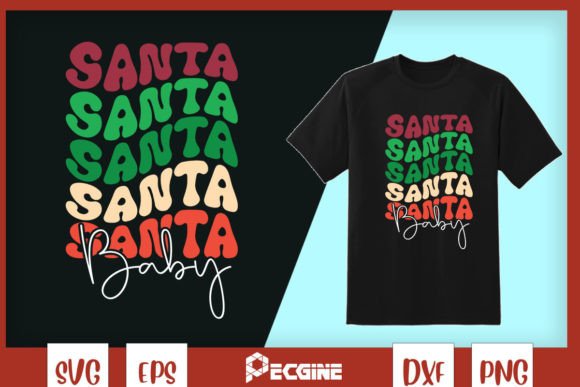
Santa Baby Retro Christmas SVG
First Impression: Playful, Nostalgic, and Ready for Stitching
When I opened the Santa Baby Retro Christmas SVG bundle, what struck me first wasn’t just the charm—it was the clarity. The design leans into mid-century holiday kitsch with clean lines, balanced negative space, and a cheeky wink in Santa’s expression. It’s not overly detailed, but it’s *intentionally* stylized: rounded letterforms, a compact Santa silhouette cradling a baby (not a doll—there’s warmth there), and subtle retro halftone texture implied in the vector outlines. As an embroidery designer, I immediately saw how this would translate—not as a dense fill-stitch monster, but as a confident, readable machine embroidery design that breathes on fabric.
A Real Project Test: Embroidering a Holiday Tote for My Local Boutique
Last week, I prepped this design for a limited-run embroidered tote bag—cotton canvas, medium weight, natural unbleached tone. I chose Santa Baby Retro Christmas SVG because my client wanted something festive but not cloying; something that felt handmade, not mass-produced. We skipped glitter thread and went for matte cottons: deep cranberry for Santa’s suit, cream for the baby blanket, and charcoal grey for the text. The result? Crisp satin stitch edges, no puckering, and zero distortion—even at 4.2" wide. Customers noticed it instantly: “It’s vintage but fresh,” one said. That’s the sweet spot this design hits. It works equally well on a sweatshirt cuff, a baby onesie chest placement, or a tea towel corner—always legible, never fussy.
Where It Shines (and Where to Pause)
- Custom apparel: Stitches cleanly on stable knits (like fleece-lined sweatshirts) and woven fabrics (denim, canvas, linen). The design’s open structure avoids heavy stitch density—no sinking into plush fabric or shadowing on textured weaves.
- Baby embroidery & nursery decor: Its gentle scale and soft curves make it ideal for onesies, burp cloths, and pillow covers—no sharp corners or tiny elements that fray after washing.
- Embroidered patch potential: With its bold outline and minimal interior detail, Santa Baby Retro Christmas SVG converts beautifully to a sew-on or iron-on patch. Just add a clean merrow edge in your digitizing software.
- Etsy seller & small shop product: It reads well in printable mockups—especially against warm neutrals or muted reds—and supports cohesive branding across holiday listings (think matching mugs + totes + aprons).
Use With Intention—Not Assumption
This isn’t a “set-and-forget” embroidery file. Its retro personality means contrast matters. On dark fabric? Stick to light thread colors—but test first: some cream threads mute on charcoal, while off-white pops. On stretchy fabric like jersey? Use cutaway stabilizer *under* and tear-away *on top*—the curved Santa hat brim needs support, or it’ll ripple. And avoid placing it directly over seams or darts: the design’s symmetry can warp on curved surfaces like cap fronts unless hooped precisely.
Also, don’t rush the corners. That tiny star above “Baby” is charming—but at under 3mm wide, it demands careful digitizing or manual trimming if used as an applique design. If you’re selling finished products, confirm whether your embroidery software renders that element crisply at 3.5". I ran a test on a scrap of terry cloth kitchen towel: the star held up, but only with medium-weight stabilizer and reduced top tension.
What This Design Says About Your Brand—Before a Single Stitch
Santa Baby Retro Christmas SVG doesn’t scream “holiday.” It whispers “thoughtful, curated, made with care.” That nuance builds customer trust—especially for handmade product buyers who scroll past generic snowflakes and reindeer. When stitched onto a linen apron for a baker’s holiday gift set, it signals craftsmanship, not clip art. When scaled down for a baby embroidery hoop ornament, it feels personal, not promotional. For Etsy sellers, that distinction lifts perceived value: customers pay more for designs that tell a story, not just fill space.
And yes—it performs commercially. The included SVG, PNG, DXF, and EPS files mean you can adapt it beyond embroidery: laser-cut wood ornaments, sublimation transfers, or even hand-drawn patterns for cross-stitch kits. But remember: file format ≠ usage rights. Always verify licensing before bundling Santa Baby Retro Christmas SVG into digital embroidery bundles or resale graphics.
Practical Designer Notes You’ll Actually Use
- Always test on scrap fabric first—especially with textured or dark materials. That “pre-sized” PNG is helpful, but real-world tension changes everything.
- Check thread color contrast in natural light—not just your screen. Retro palettes can fool RGB previews.
- Review stitch density visually: zoom into the SVG in your editor. Look for overlapping paths or micro-gaps that could cause jump stitches or weak fills.
- Confirm hoop size compatibility. At full width (approx. 4.5"), it fits standard 5x7 hoops—but verify clearance for your machine’s needle-to-hoop edge distance.
- Inspect small details like the baby’s mittens or Santa’s belt buckle. If digitizing from scratch, simplify—not eliminate—those features.
- Test black-and-white mockups. Does the design retain personality without color? Santa Baby Retro Christmas SVG does—and that’s rare.
- Compare light vs. dark backgrounds in your listing photos. This design gains warmth on oatmeal linen but gains sophistication on navy twill.
- Use proper stabilizer: medium cutaway for knits, tear-away for wovens, and fusible for lightweight fabrics like chambray.
- Confirm dual-use suitability: Does your license allow both personal projects *and* commercial embroidery? Don’t assume.
Final Thought: A Design That Earns Its Place
Santa Baby Retro Christmas SVG isn’t just another holiday graphic. It’s a quiet workhorse—stylish enough for boutique branding, sturdy enough for daily-use embroidery, and flexible enough for craft business owners juggling Etsy listings, craft fairs, and custom client requests. It won’t solve every project, but when you need warmth without cliché, nostalgia without clutter, or charm without compromise—it’s the kind of design you keep in your “go-to” folder. Just remember: even the best embroidery file needs your eye, your hand, and your judgment. Run that test stitch. Feel the fabric. Then make it yours.