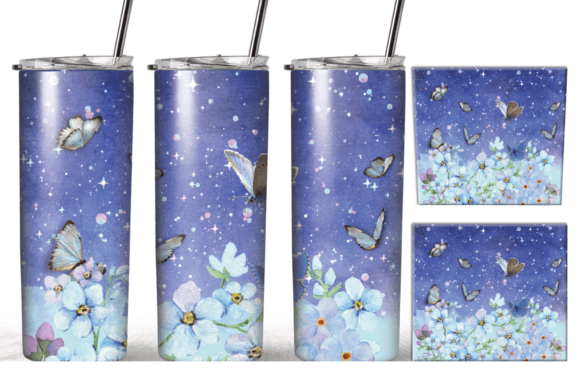
Blue Flowers Watercolor Tumbler Wrap
A Designer’s First Glance: Soft, Fluid, and Purpose-Built
When I opened the Blue Flowers Watercolor Tumbler Wrap, my first thought wasn’t “pretty”—it was “intentional.” The soft-edged blossoms, gentle washes of blue and sage, and organic flow across the 9.3 x 8.2 inch template tell me this wasn’t sketched for a mug—it was composed for curvature. That subtle taper? It’s not just aesthetic; it’s functional geometry for wrapping around a 20 oz skinny tumbler. As an embroidery designer who regularly adapts graphics for stitch, I immediately recognized its sublimation roots—but also saw how its watercolor looseness could translate beautifully to satin-stitched petals or layered fill-stitch foliage on a custom embroidered tote bag or linen tea towel.
Where This Design Finds Its Real-Life Rhythm
Last week, I prepped a small batch of personalized baby gifts for a local boutique: organic cotton swaddles, muslin bibs, and linen pillow covers. I pulled up the Blue Flowers Watercolor Tumbler Wrap not to wrap a tumbler—but to isolate a single floral cluster for a delicate corner motif on a newborn’s blanket. Why? Because its open negative space, low-detail centers, and flowing outlines hold up at 3.5 inches wide without turning muddy in thread. On a sweatshirt? Yes—but only as a centered chest accent, not a full back design. On a cap? Too wide and too fluid for clean curve-hooping; better suited for a flat-panel apron or a relaxed-fit tote bag where the drape supports the design’s natural asymmetry.
What Works—and What Needs Thoughtful Editing
- Works well for: Linen tea towels, cotton canvas totes, lightweight sweatshirts (front chest), nursery pillow covers, holiday gift tags, and boutique-branded kitchen linens. Its watercolor softness reads as handmade—not mass-produced—especially when stitched with matte cotton thread.
- Use carefully on: Stretchy knits (the taper can distort under tension), dark fabrics (some light-blue washes may need underlay or color-adjusted thread), and curved surfaces like caps or curved pockets (the straight + tapered PNGs help, but stitching still requires careful hooping and stabilizer choice).
- Not ideal for: Tiny hoop sizes (<4" diameter), ultra-dense applique designs, or projects requiring crisp line work or fine lettering—the design leans into suggestion, not precision.
Stitching Clarity Meets Customer Trust
I’ve seen too many craft businesses lose repeat buyers because a “watercolor” design looked pixelated or overly saturated after embroidery. The Blue Flowers Watercolor Tumbler Wrap avoids that trap. Its high-res PNG gives clean edges for digitizing—no jagged halos, no ambiguous gradients. When converted to a machine embroidery design, those soft transitions become intentional satin-stitch blends or air-assisted fill areas. That builds customer trust: when a client sees a preview mockup and then receives a finished product where the embroidery breathes like the original graphic, they feel confident in your craftsmanship—not just your software skills.
Practical Notes Every Embroidery Designer Should Check
- Test the isolated floral cluster on scrap fabric first—especially if using textured weaves like burlap or heavy linen.
- Review stitch density: watercolor-inspired fills often benefit from slightly reduced density to preserve translucency in thread.
- Confirm hoop size compatibility—this design spans nearly 9 inches, so plan for a 5x7 hoop minimum, or split intelligently for smaller frames.
- Inspect small details at actual stitch scale: petal tips, stem ends, and overlapping leaves should remain legible at your intended final size.
- Try black-and-white mockups: does the contrast hold? Does the shape read clearly without color cues?
- Compare light and dark fabric backgrounds—some mid-tone blues may recede on navy or charcoal unless backed with white underlay.
- Choose stabilizer wisely: tear-away works for stable cottons; cut-away adds support for knits or lightweight rayon.
- Verify licensing: since this is a digital embroidery file sold as a Graphics asset, confirm whether commercial use (e.g., selling finished embroidered totes on Etsy) is permitted before listing.
Fitting Into Your Craft Business—Without Forcing It
The Blue Flowers Watercolor Tumbler Wrap doesn’t scream “bestseller”—it whispers “thoughtful detail.” That makes it perfect for makers who sell curated collections: a set of three embroidered kitchen towels (one with this floral wrap adapted as a border), matching baby bibs and burp cloths, or a limited-run holiday gift box featuring hand-stitched linen pouches. It’s not a logo replacement or a bold branding statement—it’s a quiet signature. For Etsy sellers, that’s valuable: customers searching for “soft floral embroidery,” “nursery linen design,” or “minimalist watercolor tote bag” will connect with its mood long before they notice technical specs.
Final Take: A Design That Respects the Process
This isn’t a plug-and-play embroidery file—it’s a starting point shaped by real constraints (tumbler curvature, sublimation clarity, printable mockup readiness). As a designer, I appreciate that. It invites adaptation instead of demanding compliance. Whether you’re digitizing it for a custom embroidered patch, scaling it for a sweatshirt front, or isolating elements for a printable craft kit, the Blue Flowers Watercolor Tumbler Wrap holds up because it was built with texture, scale, and human perception in mind—not just screen resolution. In Crafts, that kind of intentionality is rare. And in your hands? It’s not just a download. It’s a quiet collaborator.